
Italy works well in twelve days if you focus on Rome, the Amalfi Coast, Florence, Venice and Milan, because almost everything is linked by train. This guide gathers what a Mexican traveler should check before buying a ticket. It is not a firsthand travel account: it is information from official sources plus editorial recommendations. Anything we could not confirm is marked as pending.
For the big picture on the Schengen area, the EES and ETIAS, read our guide to entry requirements for Europe first; here we only summarize what changes when you enter through Italy. If you are also going to Spain, see traveling to Spain from Mexico.
Entry requirements
Visa and stay. Mexicans enter the Schengen area without a visa for short stays: up to 90 days in any 180-day period, adding up all countries. We could not open Regulation (EU) 2018/1806 or Italy's visa portal, so confirm your case in the SRE Traveler's Guide or with the Italian Embassy before you buy.
Passport. Your Europe and italia.it ask for it to be valid for at least three months after your planned departure date (and, according to Your Europe, issued within the previous 10 years). The SRE, however, speaks of a minimum validity of six months. As an editorial margin, travel with at least six months so an airline does not refuse boarding.
What the border may ask for. According to Your Europe, you must be able to justify the purpose of the trip and have enough funds; if you do not meet the conditions, entry may be refused. Carry your return ticket, hotel bookings and itinerary printed or downloaded. The minimum amount per person per day that Italy sets is in a table from its Ministry of Foreign Affairs that did not load: pending.
EES and ETIAS. The EES has been operating since 10 April 2026: at the border they take fingerprints and a photo and record your entry and exit. ETIAS, according to the European Commission, does not exist yet as a procedure and has no date; some press reports speak of 2027, without official confirmation. Beware of sites charging for an "ETIAS" that cannot be applied for. See the detail in the Europe guide.
Insurance. The SRE recommends major medical or travel insurance valid in Italy. We found no official source that requires it for Mexican tourists without a visa; as an editorial recommendation, get a policy with medical and cancellation cover.
Cash. If you carry 10,000 EUR or more (or its equivalent), you must declare it to customs when entering the EU (Your Europe). Italian customs forms and penalties: pending.
Flights from Mexico
We did not verify airlines, frequencies or duration for Mexico-Rome or Mexico-Milan flights: pending. We publish no fares either. If you connect in another country, check its transit requirements for Mexicans. Flying into Rome and out of Milan (an open-jaw ticket) saves you from backtracking; check the price with your airline.
Money, plugs and connectivity
- Currency. The euro; cash and cards are accepted, and there are exchange offices at airports and stations (italia.it). Peso rate and your bank's fees: pending.
- Plugs. 220 V and 50 Hz (italia.it). Your 127 V appliances need an adapter and, if they are not dual-voltage, a converter; check the label.
- Emergencies. 112 is the single, free number (italia.it).
- Connectivity. Roaming, eSIM or prepaid SIM: rates and options pending.
Getting around: Trenitalia and Italo
The two high-speed operators are Trenitalia (Frecciarossa and Frecciargento, plus Intercity and regional trains) and Italo. According to Italo, direct journeys take from 1 h 30 min from Rome to Florence, 2 h 15 min from Florence to Venice and 2 h 30 min from Venice to Milan; Rome to Naples, 1 h. Timetables, stations per train and fares depend on the date: pending.
Two practical points from Trenitalia: paper tickets on regional trains are validated at the station machine before boarding and used within the next 4 hours; digital tickets are not validated. And if you drive instead of taking the train, the ZTLs (limited traffic zones) in historic centers do not allow access without a permit, with rules that vary by city (italia.it); fine amounts are pending. There is a strike notice for 20 to 21 November 2026: check your date before you travel.
A 12-day route: Rome, Amalfi Coast, Florence, Venice and Milan
You enter through Rome and leave from Milan. Train times come from Italo; sightseeing hours and transfers to the coast are not verified, so book ahead and confirm each site.
- Day 1, Rome. Arrive at Fiumicino, transfer to Roma Termini and rest.
- Day 2, Rome. Classic Rome: Colosseum and Forum. Tickets and hours: pending.
- Day 3, Rome. The Trevi Fountain, which requires a ticket since 2 February 2026, and a walk through the center.
- Day 4, Rome. Free day or day trip; tomorrow you head to Naples (1 h by Italo from Rome).
- Day 5, to the Amalfi Coast. Train to Napoli Centrale and transfer to Positano. Naples-coast leg: pending.
- Day 6, Amalfi Coast. Positano and surroundings. Buses and ferries: pending.
- Day 7, to Florence. Back to Naples and train to Florence (from Rome, 1 h 30 min by Italo). Count on a nearly full travel day.
- Day 8, Florence. Florence: cathedral, Ponte Vecchio and museums. Tickets: pending.
- Day 9, to Venice. Train from Florence to Venezia Santa Lucia (from 2 h 15 min by Italo).
- Day 10, Venice. Venice: St Mark's Square and Rialto. Access fee for day visitors: pending.
- Day 11, to Milan. Train from Venice to Milano Centrale (from 2 h 30 min by Italo) and an afternoon in Milan.
- Day 12, return. Transfer to Malpensa and fly to Mexico.
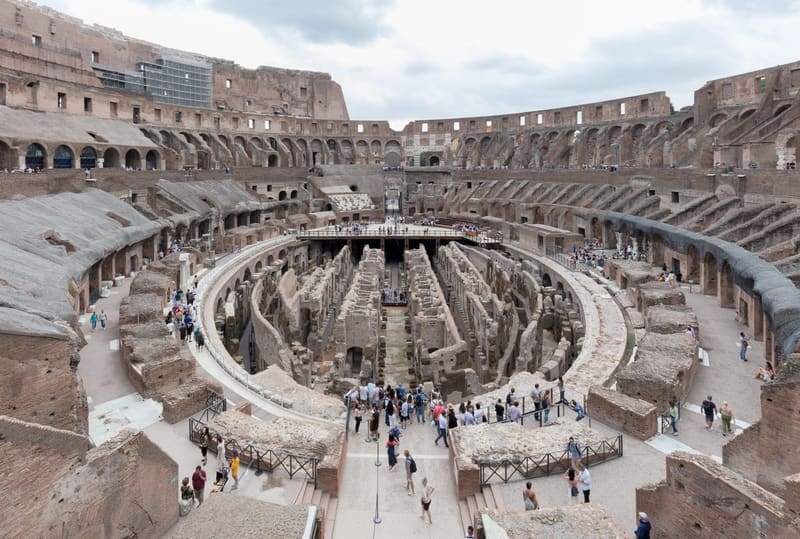 Inside the Colosseum, Rome (day 2). Photo: Diego Delso, delso.photo / Wikimedia Commons, CC BY-SA 4.0.
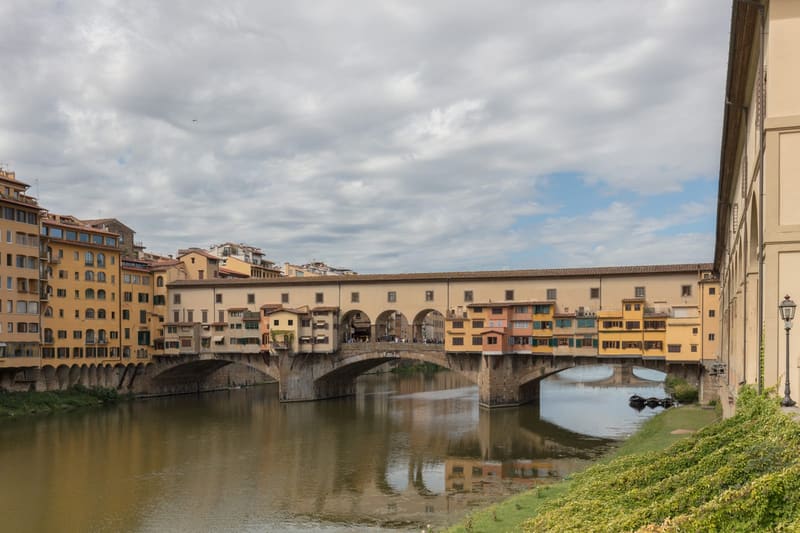 Ponte Vecchio, Florence (day 8). Photo: Diego Delso, delso.photo / Wikimedia Commons, CC BY-SA 4.0.
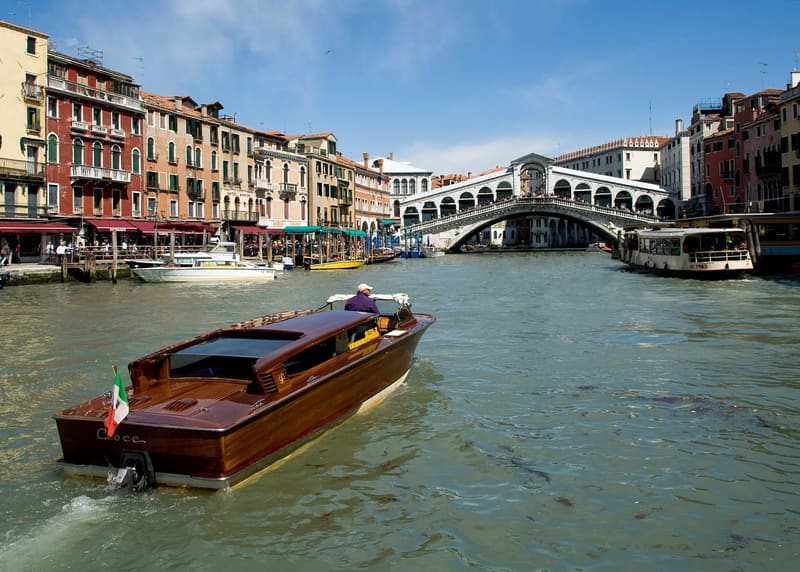 Rialto Bridge over the Grand Canal, Venice (day 10). Photo: Saffron Blaze / Wikimedia Commons, CC BY-SA 3.0.
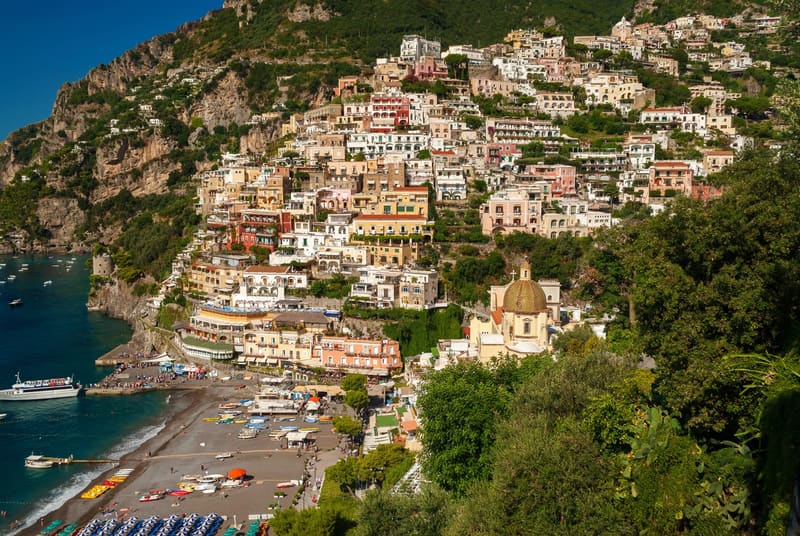 Positano, Amalfi Coast (day 6). Photo: Mihael Grmek (Meho29) / Wikimedia Commons, CC BY-SA 4.0.
When to go
We did not open an official weather source, so we give no temperatures or exact months. As an editorial recommendation: spring and autumn are usually more comfortable than summer for walking cities like Rome and Florence, and on the coast tourist services (ferries, for example) often depend on the season: confirm with the operators. High-season and event dates: pending.
Fees and access restrictions
- Trevi Fountain. Since 2 February 2026, access to the fountain costs 2 EUR for tourists and non-residents, every day from 9:00 to 22:00; there are exemptions and the stated validity runs to 31 December 2027 (turismoroma.it).
- Venice. There is an access fee for day visitors on selected dates; the official site did not load and we did not confirm fees, exemptions or the 2027 calendar: pending.
- Accommodation tax. Rome charges a contributo di soggiorno with rates in force since 1 October 2023; amounts, and those of other cities: pending. Ask your hotel what is charged and when.
- ZTL. See the getting-around section.
Safety and consulate
Before you leave, check the SRE Traveler's Guide and the notices from the Mexican Embassy in Italy and the Consulate General in Milan. The SRE published on 23 December 2024 the phone numbers of the Embassy (+39 06 441 60 61) and the Consulate in Milan (+39 02 7600 2310); the Traveler's Guide and the Embassy page did not open in our check, so we could not confirm the current advisory. As an editorial recommendation, keep a copy of your passport in your email, separate from the original. What to do if you lose your passport is in the Europe guide.
Map and getting there
- Rome-Fiumicino Airport · open in Maps ↗
- Roma Termini Station · open in Maps ↗
- Colosseum, Rome · open in Maps ↗
- Trevi Fountain · open in Maps ↗
- Napoli Centrale Station · open in Maps ↗
- Positano · open in Maps ↗
- Firenze Santa Maria Novella Station · open in Maps ↗
- Florence Cathedral (Santa Maria del Fiore) · open in Maps ↗
- Ponte Vecchio, Florence · open in Maps ↗
- Venezia Santa Lucia Station · open in Maps ↗
- St Mark's Square, Venice · open in Maps ↗
- Rialto Bridge, Venice · open in Maps ↗
- Milano Centrale Station · open in Maps ↗
- Milan Cathedral (Duomo) · open in Maps ↗
- Milan Malpensa Airport · open in Maps ↗
- Embassy of Mexico in Italy (Rome) · open in Maps ↗
- Consulate General of Mexico in Milan · open in Maps ↗
Sources and verification
Every practical fact carries a label. Ours we saw it or paid for it ourselves. Official published by the authority or the operator. Third party reported by another outlet or an external calculation. Pending still to be confirmed.
- Your Europe: travel documents for non-EU nationals. Opened. Passport with three months after departure and issued within 10 years, 90 days in 180 in 29 countries, funds, refusal. Checked by the EU on 19 August 2026. Consulted on 20 November 2026.
- Your Europe: traveling with cash. Opened. Declaration of 10,000 EUR or more when entering or leaving the EU; penalties if not declared. Checked by the EU on 21 September 2026. Consulted on 20 November 2026.
- European Commission: Entry/Exit System (EES). Opened. Phased start on 12 October 2025; fully operational on 10 April 2026; data recorded. Updated on 10 April 2026. Consulted on 20 November 2026.
- European Commission: ETIAS. Opened. Not operating, no date, expected 20 EUR fee; page of 6 October 2025. Consulted on 20 November 2026.
- European Union: EES and ETIAS travel site. Opened, but showed no readable content on 20 November 2026. Check the current ETIAS status there before you buy your flight.
- Regulation (EU) 2018/1806 (EUR-Lex). Not opened in this consultation; the Commission's visa-exempt countries page returned 404 on 20 November 2026. Confirm that Mexico appears in Annex II.
- italia.it: practical information for traveling to Italy. Opened. Passport with three months after leaving Schengen, euro, 220 V and 50 Hz, emergencies 112, ZTL. Undated (mentions the end of the Green Pass on 1 June 2022). Consulted on 20 November 2026.
- SRE: travel recommendations for Italy 2024-2025. Opened. Passport with a minimum validity of six months, insurance recommended, funds with no amount, phone numbers of the Embassy and the Consulate in Milan. Published on 23 December 2024. Consulted on 20 November 2026.
- Mexican Embassy in Italy: traveling to Italy. Blocked by a browser check on 20 November 2026. Unconfirmed.
- SRE Traveler's Guide: Italy. Did not open on 20 November 2026 (the domain did not respond). Unconfirmed.
- Ministero degli Affari Esteri: means of subsistence table. Blocked by a browser check on 20 November 2026. Minimum amounts, unconfirmed.
- Vistoperitalia (MAECI): visa portal. Returned HTTP 404 on 20 November 2026. Unconfirmed.
- Trenitalia: services and booking. Opened. Frecciarossa, Frecciargento, Frecciabianca, Intercity and Regionale; booking through site, app and agencies. No validity date (2025 footer). Consulted on 20 November 2026.
- Trenitalia: traveling on regional trains. Opened. Validation of paper tickets before departure, until 23:59 on the printed date, use within 4 hours, digital tickets not validated. No validity date (2025 footer). Consulted on 20 November 2026.
- Italo: journeys and booking. Opened. Direct journey times between Rome, Florence, Venice, Milan and Naples; strike notice of 20 to 21 November 2026. No validity date. Consulted on 20 November 2026.
- Turismo Roma: new access system for the Trevi Fountain. Opened. 2 EUR ticket since 2 February 2026, hours 9:00-22:00, exemptions. Validity from 30 January 2026 to 31 December 2027. Consulted on 20 November 2026.
- Turismo Roma: contributo di soggiorno of Roma Capitale. Opened. New rates since 1 October 2023 (Resolution no. 255 of 17 July 2023); lists no amounts. Consulted on 20 November 2026.
- Roma Capitale: contributo di soggiorno rates from 1 October 2023 (PDF). Compressed PDF that could not be read on 20 November 2026. Amounts, pending.
- Venice: access fee (CdA) site. Loaded no content on 20 November 2026. Calendar and fees unconfirmed.
- Wikimedia Commons: Coliseo, Roma, Italia, 2022-09-15, DD 80. Opened. Photo by Diego Delso, CC BY-SA 4.0.
- Wikimedia Commons: Ponte Vecchio sobre el río Arno, Florencia, Italia, 2022-09-19, DD 02. Opened. Photo by Diego Delso, CC BY-SA 4.0.
- Wikimedia Commons: Rialto Bridge Grand Canal. Opened. Photo by Saffron Blaze, CC BY-SA 3.0.
- Wikimedia Commons: Positano panorama 01. Opened. Photo by Mihael Grmek (Meho29), CC BY-SA 4.0.